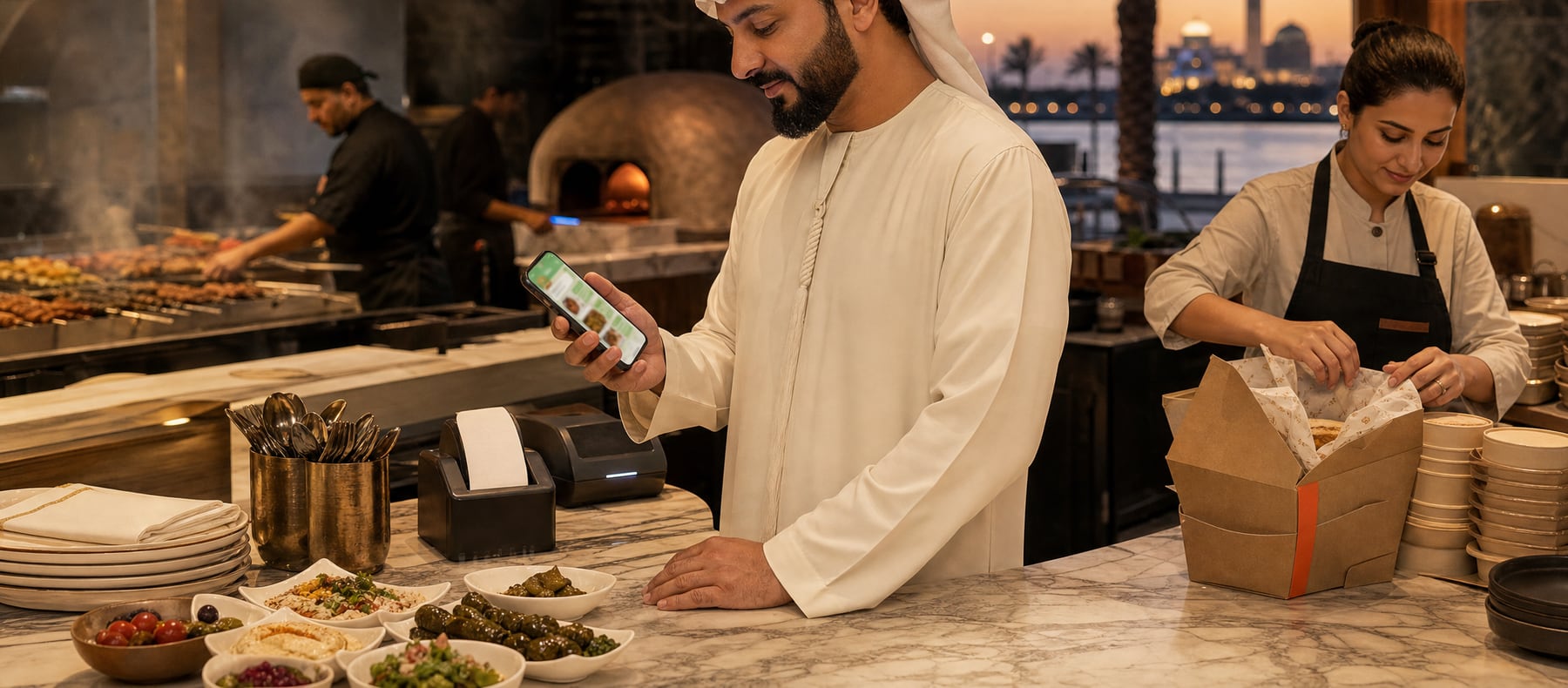
Why Abu Dhabi restaurants move repeat orders to WhatsApp
Abu Dhabi's food delivery market runs through the same aggregators as the rest of the UAE — Talabat, Noon Food, Deliveroo and Careem NOW. Each charges a base commission, often layers on an ad-boost fee, and asks the outlet to co-fund promotions. Stacked together, the typical all-in take sits in a 25-35% band of order value. Aggregators remain a strong discovery channel; what changes is the second, third and fifth order from the same guest — repeat business that should carry the thinnest acquisition cost of any order.
WhatsApp is where that repeat guest already is — the default messaging app across every nationality in Abu Dhabi, and already the channel a guest uses to ask about delivery timing. Turning that thread into an ordering surface — bilingual catalog, payment link, kitchen ticket — keeps the repeat relationship, and its margin, with the outlet instead of the aggregator.
The WhatsApp order flow
The order flow is short by design. A guest messages the WhatsApp Business number — triggered by a table QR, a delivery-bag insert or a Google Business Profile message button — and receives a Meta Catalog menu with Arabic and English names, AED prices and item photos. They build a cart inside the same chat, confirm it, and receive a payment link (card or Apple Pay) from the connected UAE gateway. The moment payment clears, the order drops into a single live queue alongside every aggregator order, and a kitchen ticket (KOT) prints to the correct station.
No app download, no new login, no separate tablet. Because the ordering platform and the WhatsApp Business API sit on the same stack — Ordering Suite paired with the Go4WhatsApp BSP — provisioning typically takes 24-48 hours, and most single-outlet restaurants are fully live inside 48 hours.
Neighbourhood playbook — Al Reem to Mussafah
Abu Dhabi is not one delivery pattern. The tactics below are qualitative — how to use the same WhatsApp catalog differently by neighbourhood, not a ranking of areas.
Al Reem Island, Khalidiya and the Corniche — residential delivery
Dense residential pockets with a steady evening delivery pattern. The highest-leverage tactic is a delivery-bag insert card — Arabic on one side, English on the other — pointing back to the WhatsApp number so the second order skips the aggregator app. A pinned catalog message with the week's specials, sent only to opted-in guests, keeps the channel warm between orders.
Al Zahiyah and downtown — office lunches
Downtown and Al Zahiyah carry a heavy weekday office-lunch pattern: same building, same order window, different colleague each day. A shared catalog link in an office group chat, plus a standing lunch-set pinned at the top, turns a single admin's order into repeat traffic at zero discovery cost.
Yas Island and Saadiyat — leisure and short-stay guests
Yas and Saadiyat see a leisure and short-stay guest base — hotel guests, weekend visitors, families at beach clubs and attractions. A QR on the table or sunbed opening a pre-filled WhatsApp greeting captures the order without an aggregator app, and the same contact becomes a return channel for their next visit.
Mussafah and ICAD — industrial-area bulk catering
Industrial areas run on standing bulk orders, not single-guest delivery: labour accommodation meal contracts, site canteens, and recurring office catering. A catalog built around fixed-quantity meal boxes, with the payment link sent to one procurement contact rather than dozens of guests, matches how these orders are placed and paid.
Arabic-first catalog for Abu Dhabi
Abu Dhabi, as the UAE capital, carries a larger share of Emirati and wider Arab-family resident demand than Dubai's more expat-weighted mix — a qualitative difference that shapes how a WhatsApp menu should be built. Meta Catalog supports Arabic and English side by side on every SKU, with native right-to-left rendering inside the thread.
For an Abu Dhabi outlet, leading with the Arabic name and treating English as the secondary line — rather than the reverse pattern that suits some Dubai neighbourhoods — tends to match how the family order-taker reads the menu. See our Arabic-first WhatsApp catalog guide for the field-by-field build.
Ramadan iftar pre-orders and family boxes
Ramadan changes the order pattern for the month: iftar timing concentrates demand into a narrow window, and family-size boxes replace the single-portion order as default. A WhatsApp catalog can carry a dedicated Ramadan section — iftar set menus, family boxes, suhoor add-ons — that guests browse and pre-order earlier in the day, smoothing the kitchen's iftar-hour rush.
Any broadcast promoting the Ramadan menu must go only to guests already opted in under WhatsApp Business Policy. A pinned catalog update inside existing threads works just as well and carries no opt-in risk.
Cloud kitchens in Abu Dhabi — multi-brand routing
Cloud kitchens running more than one virtual brand out of a single production space can give each brand its own WhatsApp catalog and, where useful, its own number, while multi-brand routing sends every confirmed order into the correct kitchen station automatically. The guest never needs to know two brands share a kitchen; revenue-by-channel reporting keeps each brand's WhatsApp, aggregator and QR-menu orders visible separately. Our cloud kitchen UAE guide covers the wider setup.
Missed calls — auto-reply with the ordering link
A ringing phone that goes unanswered during a lunch rush is a lost order by default. The Ordering Suite's missed-call auto-reply closes that gap: when a call goes unanswered, the caller automatically receives a WhatsApp message with the outlet's ordering link, turning a dropped call into a live thread with a catalog one tap away.
Talabat, Noon, Deliveroo, Careem and WhatsApp in one queue
None of this requires dropping the aggregators. Talabat, Noon Food, Deliveroo and Careem NOW all sync into the same live order queue as WhatsApp and QR-menu orders, so kitchen staff work from one screen, and management gets a single revenue-by-channel report instead of separate dashboards plus an unreported WhatsApp inbox. See the full Talabat vs Noon vs Deliveroo vs Careem commission comparison for how the aggregator side breaks down.
FTA VAT, ADAFSA and trade licence notes
WhatsApp ordering creates no new compliance obligations — it inherits what the outlet already carries. Every paid order still needs an FTA VAT-compliant tax invoice at the UAE's 5% rate, itemised and showing the outlet's TRN. Food-safety oversight sits with the Abu Dhabi Agriculture and Food Safety Authority (ADAFSA), and the trading licence runs through the Abu Dhabi DED or the relevant free zone authority — both should be in place before any ordering channel goes live.
Opt-in broadcast rules
Every WhatsApp Business marketing message needs a documented opt-in — a scanned table QR, a wa.me link click, or an explicit request to receive offers all count. Utility messages tied to an active order do not need the same opt-in, but every broadcast still needs a clear opt-out path. Getting this wrong risks the WhatsApp number itself, not just one campaign, so opt-in hygiene is a fixed rule, not a judgment call.
48-hour setup
Setup runs on the same BSP-assisted path across the UAE: Meta Business Verification, WhatsApp Business API number provisioning through the Go4WhatsApp BSP (typically 24-48 hours), bilingual Meta Catalog import, and payment-gateway wiring. Most single-outlet Abu Dhabi restaurants are fully live — catalog live, payment link tested, kitchen ticket printing — inside 48 hours of starting.
Cost — what you pay and don't
The Ordering Suite runs at $9/month or $90/year, no annual lock-in, and a 14-day free trial with no card required. It includes WhatsApp catalog and ordering, QR menu, menu manager, multi-brand routing and revenue-by-channel reporting, with zero transaction fees — only the gateway's own standard rate applies. Full feature detail is on the WhatsApp ordering product page.
An outlet wanting an on-premise Windows terminal can add Desktop POS at $150/year — offline mode, VAT calculation, multi-station KOT, multi-printer support — see our UAE POS page. Compare a typical 25-35% commission band against a fixed subscription plus normal processing; the crossover depends on the outlet's own average ticket. Full pricing is on the pricing page.
Who this is for
This fits an Abu Dhabi outlet already taking aggregator orders and building a parallel, lower-cost channel for repeat guests — a Khalidiya cafe wanting fewer aggregator-app reorders, a Reem Island kitchen running more than one brand, a Yas or Saadiyat outlet serving a leisure crowd, or a Mussafah catering operation running bulk orders that were never a fit for a per-guest listing.
Ship WhatsApp ordering for your Abu Dhabi restaurant — $9/month, live in 48 hours
Online eMenu Ordering Suite runs WhatsApp catalog, orders, KOT routing and FTA-compliant tax invoicing for $9/month per outlet. Bilingual Arabic + English out of the box. WhatsApp us on +971 54 508 5552 for the 48-hour BSP-assisted setup, or see the pricing card first.
WhatsApp us — +971 54 508 5552 See pricingFrequently Asked Questions
Is WhatsApp Business API available in Abu Dhabi?
Yes. WhatsApp Business API works the same way across every emirate, including Abu Dhabi, and is provisioned through a Meta-approved Business Solution Provider (BSP) such as Go4WhatsApp, not sold directly by Meta. WhatsApp runs over data, not SMS, so no separate telecom licence is needed. Typical provisioning is 24-48 hours.
How much does WhatsApp ordering cost for an Abu Dhabi restaurant?
Ordering Suite, which includes WhatsApp catalog and ordering, is $9/month or $90/year, no annual lock-in, and a 14-day free trial requiring no card. There are zero transaction fees — the only extra cost is the gateway's standard rate and Meta's per-conversation charges, which scale with message volume, not order value.
Can a WhatsApp catalog show my menu in Arabic and English for Abu Dhabi guests?
Yes. Meta Catalog supports bilingual product names and descriptions on every SKU, with native right-to-left rendering inside the thread. Abu Dhabi's guest base skews toward more Emirati and Arab-family demand than Dubai's more expat-weighted mix, so many capital outlets lead with the Arabic name and treat English as the secondary line.
How does WhatsApp ordering compare to Talabat, Noon, Deliveroo and Careem commission?
Aggregator commission in the UAE typically runs in a 25-35% all-in band of order value once base commission, ad-boost and promotional co-funding stack together. WhatsApp direct ordering carries no per-order commission — a flat monthly subscription plus the gateway's standard rate. The exact saving depends on the outlet's own average ticket and how much volume shifts to the direct channel.
Is WhatsApp ordering FTA VAT compliant for Abu Dhabi restaurants?
Yes, provided the outlet issues a proper FTA tax invoice on every order — 5% VAT, itemised, with the outlet's TRN shown. Online eMenu calculates VAT automatically and generates the compliant invoice per order, regardless of channel.
Do I need an ADAFSA permit and a trade licence to accept WhatsApp orders in Abu Dhabi?
Yes. Any paid food order in Abu Dhabi needs a valid permit from the Abu Dhabi Agriculture and Food Safety Authority (ADAFSA) and a trading licence through the Abu Dhabi Department of Economic Development (DED) or the relevant free zone authority. WhatsApp ordering adds no new licence requirement — it just needs existing compliance in place.
Can Abu Dhabi restaurants send Ramadan iftar and family box offers over WhatsApp?
Yes, but only to guests who have already opted in under WhatsApp Business Policy — a table QR scan, a wa.me link click or an explicit request to receive offers all count. Pinning a Ramadan section inside the existing bilingual catalog avoids any opt-in question, since it reaches guests already inside an active thread rather than through a broadcast.
How long does WhatsApp ordering setup take for an Abu Dhabi restaurant?
About 48 hours end to end for most single-outlet restaurants. WhatsApp Business API provisioning typically takes 24-48 hours, and Meta Catalog import, payment-gateway wiring and the first opt-in flow fit inside the same window.