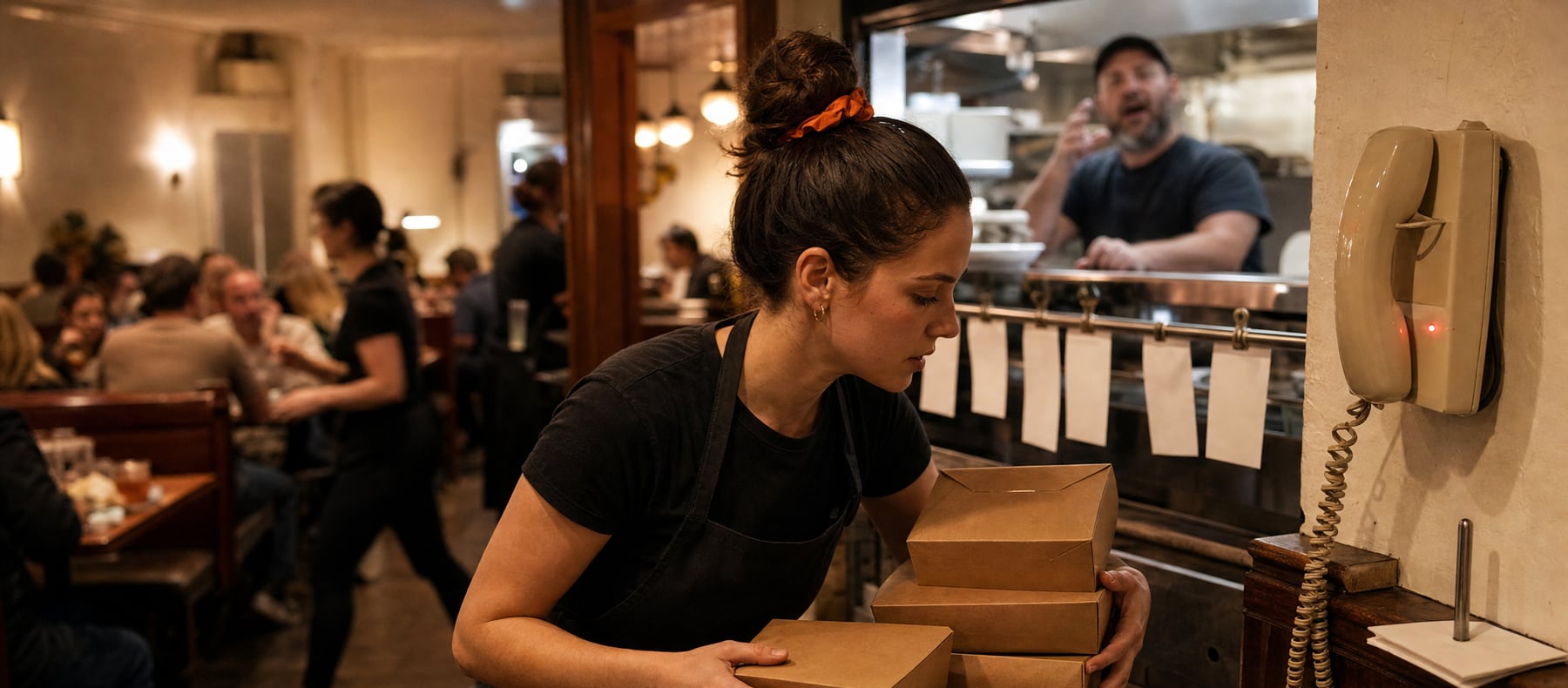
What is a missed-call problem in a restaurant?
A missed-call problem is when a restaurant's phone rings during service and nobody answers it in time — the call rolls to voicemail, rings out, or the caller hangs up before anyone picks up. It happens most during peak service, when every team member is already occupied with in-restaurant guests, and it silently costs orders, reservations, and repeat customers who don't call back.
How many calls do restaurants miss?
Industry reports converge on a striking baseline: the average restaurant misses roughly 150 calls a month, according to Revmo's State of Calls 2026 as covered by Food & Beverage Magazine. QSR Magazine's research on quick-service restaurants specifically puts the miss rate at roughly 40% of inbound calls — meaning two out of every five calls to a typical QSR go unanswered.
That is not a fringe number for a handful of outlier restaurants. It is the median experience across a segment where the same 1-3 people running the front of house are also the people expected to answer the phone. A restaurant doing steady dinner-rush volume five nights a week accumulates missed calls the way it accumulates dish breakage — quietly, a few at a time, until someone finally adds it up.
The Washington Hospitality Association's research, as cited in industry coverage, adds the detail that matters most for revenue: roughly 60% of missed calls carry actual order or booking intent. These are not robocalls or wrong numbers. Most of a restaurant's missed calls are customers who wanted to give the restaurant money.
What does a missed call cost a restaurant? (the math)
Nationally, QSR Magazine estimates the restaurant industry loses about $20.1 billion a year to unanswered calls. That figure only means something once it's brought down to the level of a single operator's Friday night, so here is an illustrative worked example — not a guarantee, just the math laid out with the public figures above.
Take a restaurant that misses 10 calls during a single peak dinner service. Apply the Washington Hospitality Association's cited figure that roughly 60% of missed calls carry order intent, and a modest $40 average order value. Run that math across a year of Friday and Saturday services and the number becomes hard to ignore.
| Illustrative math | Value (USD) | Value (GBP, approx.) |
|---|---|---|
| Missed calls per peak night | 10 | 10 |
| Share carrying order intent (~60%) | 6 calls | 6 calls |
| Average order value | $40 | £32 |
| Lost revenue per peak night | $240 | £192 |
| Peak nights per year (2/week × 52) | 104 | 104 |
| Illustrative annual loss | ~$41,600 | ~£33,300 |
This is illustrative math built from public industry figures, not a forecast for any specific restaurant — a busier weekend location could lose more, a slower weeknight-only concept could lose less. The point of the exercise is the order of magnitude: a handful of missed calls a night, multiplied across a year of peak services, adds up to real annual revenue, not a rounding error on the P&L.
Why do calls go unanswered after 7pm?
7pm on a Friday or Saturday is the single hardest hour to answer a phone in most restaurants, and it has nothing to do with staff attitude. It's staffing physics: the same 1-2 people at the host stand or the pass are simultaneously seating walk-ins, running food, refilling drinks, and bussing tables. A ringing phone competes with a guest standing in front of them, and the guest standing in front of them always wins.
A few structural reasons this window is worse than any other hour of the week:
- Peak call volume lines up exactly with peak walk-in volume. The hour when the most people want to order or book a table by phone is the same hour the dining room needs every hand on deck.
- Lean staffing models leave no dedicated phone-answerer. Most independent restaurants don't budget for a host whose only job is the phone; whoever's closest picks it up, or nobody does.
- Kitchen tickets take priority in the moment. A cook or expediter mid-plate isn't leaving the pass to answer a ringing landline, and shouldn't have to.
- The caller doesn't wait. Unlike a walk-in who's already committed to being there, a caller who rings out or hits voicemail has a dozen other restaurants one search away.
The takeaway is not "hire more staff" — most operators can't add a body just to answer phones during a two-hour window. The takeaway is that the fix has to work without relying on someone being free at exactly 7:15pm on a Saturday, which is why the fixes below start with the phone system itself, not the staffing model.
How do I stop missing phone orders? 5 fixes, ranked
These five fixes are ranked from zero-cost and same-day to the more involved, so an operator can start today and add layers as the missed-call rate proves it's still a problem.
Fix the ring pattern and voicemail
Most restaurant phone systems still "hunt" — ringing one line, then the next, then the next — which can burn 20-30 seconds before a caller even reaches a person or voicemail. Switching to simultaneous ring on every line answers faster the moment someone is free. Just as important: rewrite the voicemail greeting. A generic "we can't come to the phone" greeting sends a caller nowhere; a greeting that states hours, mentions the online ordering link, and promises a callback within the hour at least gives the caller a next step instead of a dead end. This costs nothing and takes 15 minutes to change on most phone systems.
Turn on missed-call text-back
Missed-call text-back automatically sends a text to anyone whose call goes unanswered — typically within seconds — with a short apology and a link to the online menu. It doesn't hold a conversation; it just gets an ordering option in front of the caller before they hang up and call the next place. Many modern phone systems and some POS providers offer this as a built-in feature; where it isn't native, a lightweight text-back tool can be layered on top of an existing number.
Put the online or WhatsApp ordering link everywhere
Every touchpoint a caller might hit before or after a missed call should carry the ordering link: the voicemail greeting, the hold message, the website header, the Google Business Profile, and the footer of a printed receipt. Our own WhatsApp ordering tool gives operators a single link that opens a menu and takes an order without an app download, which fits naturally into a voicemail script or a text-back message. The goal is that a caller who can't get through by voice always has a fallback path that doesn't require redialing.
Set up call overflow to a second phone or line
For restaurants where the missed-call rate is still high after fixes 1-3, call overflow routes any call unanswered after 3-4 rings to a second device — a manager's cell phone, a second front-of-house line, or a shared tablet at a quieter station. This adds one more chance for a human to pick up before the call rolls to voicemail, without requiring a dedicated call-taker on payroll. It works best paired with a kitchen display setup, so whoever answers on the overflow line can see what's already firing before promising a pickup time — see our kitchen display system page for how that ticket flow works.
Evaluate AI phone answering for the peak window
For the specific hours nobody can reasonably staff the phone — Friday and Saturday 6:30-8:30pm being the clearest example — AI phone answering is the fix that's starting to emerge across the industry. It's covered in full in the next section, including the honest tradeoffs and why human handoff still matters.
Is AI phone answering the fix? What's emerging
AI phone answering for restaurants is an emerging category, not a solved one. The idea is straightforward: an AI system answers the call during the hours staff can't, takes a basic pickup or delivery order or a reservation request, and hands anything unusual — allergies, large parties, a complaint, a vendor call — to a human. For the 7pm Friday window described above, that's a genuinely appealing shape, because it targets exactly the hours where staffing physics, not effort, is the constraint.
Online eMenu is building an AI phone ordering product for restaurants and running it as an early-access pilot — we're not claiming it answers every call today, and we wouldn't trust a vendor who claimed that about their own product either. Here's the honest read on where this category stands:
Pros
- Covers the exact hours nobody can staff. An AI system doesn't get pulled away to bus a table, so it can answer consistently during the busiest 90 minutes of service.
- No new headcount. It's a software layer on an existing phone number, not a person to schedule, train, and pay.
- Captures the straightforward order-intent calls — a pickup order, a simple reservation — that make up a large share of what's currently going to voicemail.
Cons
- The category is young. Voice AI for restaurant-specific menus, modifiers, and accents is harder than it looks, and quality varies a lot between vendors.
- It needs a real human-handoff path. Any AI phone system that can't cleanly route an allergy question, a complaint, or a large-party booking to a person is doing more harm than a voicemail would.
- It's not a replacement for fixes 1-4. The free and low-cost fixes still matter for every hour outside the AI's coverage window, and for restaurants not ready to pilot AI yet.
If an AI phone-answering pilot interests you, the two questions worth asking any vendor, including us, are: what happens when the AI doesn't understand the caller, and how quickly does a human get looped in. Those two answers tell you more than any demo. Read more about where our own pilot stands on the AI phone ordering page, and see the voice-ordering landscape more broadly in our AI voice ordering for restaurants 2026 guide.
Join the AI phone ordering pilot
We're building AI phone ordering for restaurants and running it as an early-access pilot with a small group of operators. If the 7pm Friday call volume sounds familiar, tell us about your restaurant and we'll follow up about joining.
Join on WhatsApp Read about the pilotWhat should I measure to track progress?
Two numbers tell an operator whether a missed-call fix is actually working, and both are worth tracking before and after any change:
- Missed-call rate — missed calls divided by total inbound calls, broken down by hour and day of week. Most phone systems and some POS call logs can produce the raw counts; the goal is to confirm the 7pm Friday/Saturday spike is real for your restaurant specifically, not just an industry average.
- Recovery rate — of the calls that were missed, what share came back as an order through a text-back link, a callback, or an online order placed shortly after. This one usually has to be tracked manually at first: did the text-back link get clicked, did the callback turn into a ticket.
Track both weekly for a month before making a change, then again for a month after. A missed-call rate that drops and a recovery rate that climbs is the clearest evidence that a fix — whether it's the free voicemail rewrite or a phone-answering pilot — is actually moving revenue, not just activity.
Who this is for
This guide is written for independent full-service and quick-service restaurant operators in the US and UK running 1-3 locations, where phone orders and reservations still carry real weight — pizza, Chinese takeout, family-style dining, and casual dinner-rush concepts especially. If your restaurant runs a strong Friday and Saturday dinner service with a lean front-of-house team and no dedicated call-taker, the math and the fixes above apply directly to your operation.
Frequently asked questions
How many calls do restaurants miss?
Industry reports, including Revmo's State of Calls 2026 as covered by Food & Beverage Magazine, put the average restaurant at roughly 150 missed calls a month. QSR Magazine's research goes further and estimates that quick-service restaurants alone miss roughly 40% of the calls they receive. For a single-location operator running a dinner rush with 2-3 people on the floor, that number tracks with what most managers already suspect but rarely measure.
What does a missed call cost a restaurant?
Nationally, QSR Magazine puts the industry-wide cost of unanswered restaurant calls at about $20.1 billion a year. At the unit level, the Washington Hospitality Association's research (as cited in industry coverage) found that roughly 60% of missed calls carry order or booking intent, not a wrong number or a spam call. As an illustrative example: a restaurant missing 10 calls on a single peak night, at a $40 average order and a 60% intent rate, is leaving real revenue on the table night after night — worked out fully in the math section above.
Why do restaurants miss so many calls after 7pm?
7pm on a Friday or Saturday is when the front-of-house staff who would normally answer the phone are seating walk-ins, running food, and bussing tables — the same 1-2 people wearing every hat at once. It is not an attitude problem; it is a staffing physics problem. The phone rings during the exact 90 minutes when nobody at the host stand or the pass has a free hand to pick it up, so the call rolls to voicemail or simply keeps ringing.
How do I stop missing phone orders?
Start with the free fixes: change the ring pattern so all lines ring together instead of hunting one at a time, and rewrite the voicemail greeting to include hours and an online ordering link. Add missed-call text-back so anyone who couldn't get through gets an automatic text with a link to order. Put the online and WhatsApp ordering link on the website, Google Business Profile, and receipts. If volume still overwhelms the team at peak, add call overflow to a second phone, and consider an AI phone-answering pilot for the hours nobody can staff the line.
Is missed-call text-back the same as a chatbot?
No. Missed-call text-back is a single automated text triggered the moment a call goes unanswered — it does not hold a conversation, it just gets an ordering link in front of the caller before they call a competitor instead. A chatbot or AI phone system carries on a back-and-forth exchange to actually take the order. Text-back is the cheaper, faster-to-deploy first step; AI phone answering is the fuller fix for restaurants still losing calls after text-back is live.
Does AI phone answering actually work for restaurants today?
AI phone answering for restaurants is an emerging category, not a mature one. Online eMenu is building an AI phone ordering product and running it as an early-access pilot rather than a finished product — we are not claiming it answers every call today. Any AI phone system, ours included, should be evaluated on how cleanly it hands off unusual requests (allergies, large parties, complaints) to a human, not just on whether it can take a straightforward pickup order.
What should I measure to know if my missed-call problem is improving?
Two numbers: missed-call rate (missed calls divided by total inbound calls, by hour and by day) and recovery rate (what share of missed callers you get back via text-back or a callback, and whether they actually complete an order). Most phone systems and POS call logs can produce the raw call count; the recovery rate has to be tracked manually at first — did the text-back link get clicked, did the callback turn into an order. Track both weekly for a month before and after any fix to see if it moved the needle.
Who should worry about missed calls the most?
Independent full-service and quick-service restaurants with 1-3 locations and no dedicated host or call-taker are the operators most exposed, especially anywhere phone orders and reservations still outweigh app-based ordering — pizza, Chinese takeout, family-style dining, and casual dinner-rush concepts. A single location doing a strong Friday and Saturday dinner service with a lean front-of-house team is exactly the profile losing the most calls, because the same 90 minutes of peak volume is also the same 90 minutes staff has zero slack to answer a ringing phone.